
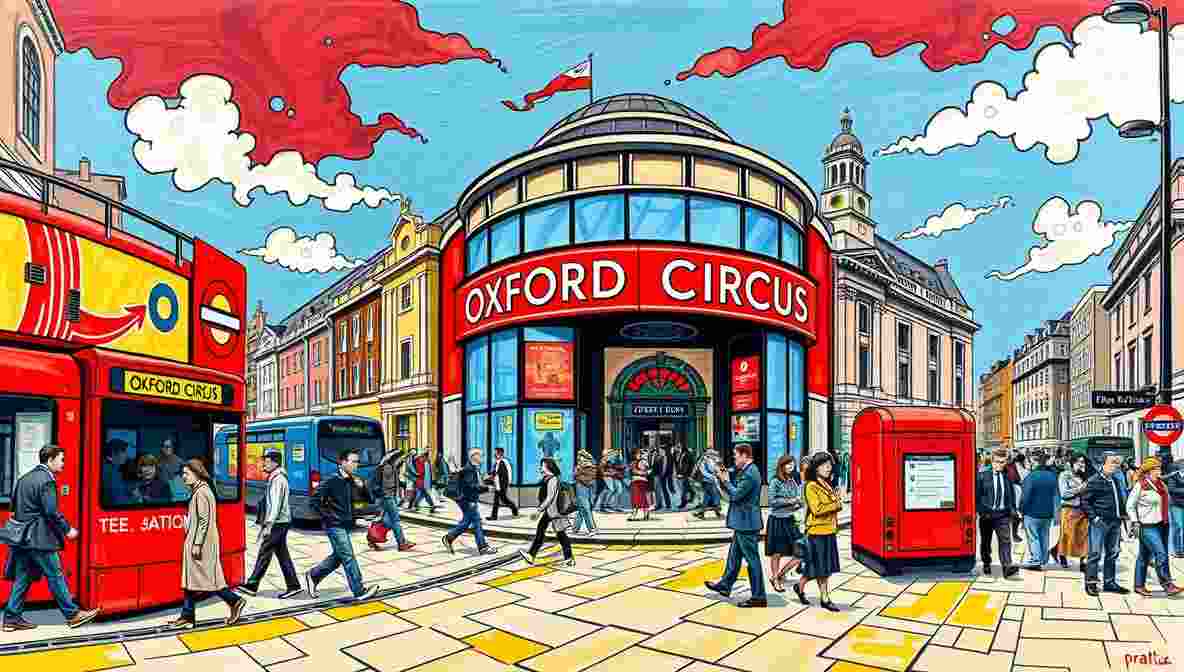
Oxford Circus Station: London’s Busiest Argument With Gravity
Oxford Circus Station is not a transport interchange. It is a live demonstration of what happens when too many humans attempt to occupy the same idea at once.
Located beneath one of the world’s busiest shopping junctions, Oxford Circus Station serves the Central, Victoria, and Bakerloo lines — a fact confirmed calmly and without irony by Transport for London
👉 https://tfl.gov.uk/plan-a-journey/stations/oxford-circus-station
This makes it the only place in London where geography, capitalism, and mild panic meet underground.
A Station Built for a City That Refused to Slow Down
Oxford Circus Station was never meant to handle the number of people who now pass through it daily. It was built when shopping involved hats and restraint, not fast fashion and emotional support bags.
TfL lists Oxford Circus as one of the busiest stations on the entire Underground network
👉 https://tfl.gov.uk/corporate/publications-and-reports/transport-statistics
This explains why the station now functions less like infrastructure and more like crowd management theatre.
The Platforms: Narrow by Tradition, Busy by Punishment
Oxford Circus platforms are famously tight. This is not a design flaw — it is a historical commitment.
Passengers stand shoulder to shoulder, pretending this is temporary. Trains arrive already full, pause briefly to accept more humans, then depart heavier but spiritually unchanged.
The Central line platform experience at Oxford Circus is specifically referenced in TfL capacity planning documents
👉 https://tfl.gov.uk/corporate/publications-and-reports/central-line
At Oxford Circus, personal space is considered optional.
The Escalators: Where Hope Goes to Queue
The escalators at Oxford Circus are not just escalators. They are emotional funnels, designed to compress thousands of people into a single direction while maintaining the illusion of choice.
During peak shopping periods, TfL regularly introduces one-way systems at Oxford Circus Station to prevent collapse
👉 https://tfl.gov.uk/status-updates/major-works-and-events/oxford-circus-station-crowd-management
Walking the wrong way here feels criminal, even if no law has technically been broken.
Signage That Assumes You’ve Been Here Before
Oxford Circus signage is clear, plentiful, and useless once the crowd reaches critical mass. Directions exist, but movement becomes theoretical.
Passengers follow signs not because they help, but because everyone else is doing it.
TfL’s station wayfinding guidance explicitly highlights Oxford Circus as a complex interchange
👉 https://content.tfl.gov.uk/station-wayfinding-standards.pdf
At Oxford Circus, instinct beats literacy.
Retail Pressure From Above, Human Pressure Below
Everything happening above ground — sales, launches, tourists discovering London through a shop window — is immediately transferred underground.
Oxford Circus Station is effectively the basement of Oxford Street, absorbing retail excess and redistributing it onto trains.
Westminster City Council planning documents acknowledge the station’s role in managing Oxford Street footfall
👉 https://www.westminster.gov.uk/oxford-street-district
The station does not serve shoppers. It processes them.
Announcements Delivered Like Emergency Broadcasts
Announcements at Oxford Circus are calm, firm, and slightly authoritarian. Instructions are repeated often, loudly, and with the tone of someone who knows they won’t be listened to.
“Please move down the platform” is less a request and more a philosophical challenge.
Accessibility That Exists, But Requires Strategy
Oxford Circus Station is partially step-free, depending on route and platform, which is TfL’s way of saying “good luck.”
TfL’s accessibility page for Oxford Circus details the station’s limitations clearly
👉 https://tfl.gov.uk/transport-accessibility/wheelchair-access-and-avoiding-stairs
Navigating these routes during peak hours feels like planning a military operation.
The Ticket Barriers: Where Everyone Becomes Equal
At Oxford Circus, everyone pauses at the barriers. Cards fail. Phones hesitate. Gates reject people who have done nothing wrong.
The station humbles all commuters equally.
Tourists, Commuters, and the Lost: United Underground
Oxford Circus is where tourists dragging shopping bags, commuters late for work, and people who took the wrong line collide politely.
British Transport Police maintain a constant presence at Oxford Circus Station because volume alone demands it
👉 https://www.btp.police.uk/area/your-area/london/london-central/
Not because of crime — because of density.
Temporary Closures, Permanently Necessary
Oxford Circus Station regularly closes entrances, exits, or entire platforms during busy periods. This is announced as “for safety reasons”, which is polite language for “this has gone too far.”
TfL routinely publishes notices specific to Oxford Circus crowd control
👉 https://tfl.gov.uk/status-updates/stations/oxford-circus
Londoners read these and nod grimly.
Conclusion: Oxford Circus Station Is Working Exactly as Intended
Oxford Circus Station is not broken. It is accurately reflecting London’s priorities.
It prioritises commerce over comfort, flow over feeling, and movement over memory. It is stressful, crowded, overwhelming — and absolutely essential.
Oxford Circus Station is not somewhere you enjoy.
It is somewhere you survive.
And then, inevitably, return to.
Continues Experimental Research on Human Density
Oxford Circus Station Continues Experimental Research on Human Density
A controlled chaos laboratory sponsored by retail.
The Shopping District Crush
- The exits feel like guesses.
- Crowds move by instinct.
- Nobody is calm.
- Everyone apologizes without stopping.
- The air smells like perfume panic.
The Retail Commuter Experience
- Tourists freeze unpredictably.
- The escalators feel competitive.
- The signage inspires faith, not clarity.
- You exit somewhere and accept it.
- Every journey is cardio.
Human Traffic Management
- Bags collide like ideas.
- The noise never finishes a sentence.
- You feel accomplished surviving.
- Nobody lingers on purpose.
- Oxford Circus Station: where movement is mandatory.

Alan Nafzger was born in Lubbock, Texas, the son Swiss immigrants. He grew up on a dairy in Windthorst, north central Texas. He earned degrees from Midwestern State University (B.A. 1985) and Texas State University (M.A. 1987). University College Dublin (Ph.D. 1991). Dr. Nafzger has entertained and educated young people in Texas colleges for 37 years. Nafzger is best known for his dark novels and experimental screenwriting. His best know scripts to date are Lenin’s Body, produced in Russia by A-Media and Sea and Sky produced in The Philippines in the Tagalog language. In 1986, Nafzger wrote the iconic feminist western novel, Gina of Quitaque. Contact: editor@prat.uk